CPA REG Section: What It Covers
A careful CPA REG section guide: ethics, tax procedures, business law, property, individual tax, and entity tax without pass guarantees.
Read it to name the pattern, then practice while it is still fresh.
Prepared by Askiras editorial team. These guides stay short on purpose: one pattern, one worked example, one clear next step into practice. How we build guides.
Uses public AICPA CPA Exam Blueprint and NASBA exam-process context; does not provide tax, accounting, legal, licensing, or filing advice.
AICPA/NASBA CPA Exam context, Askiras independence, and no unsupported outcome claims.
What does the CPA REG section cover?
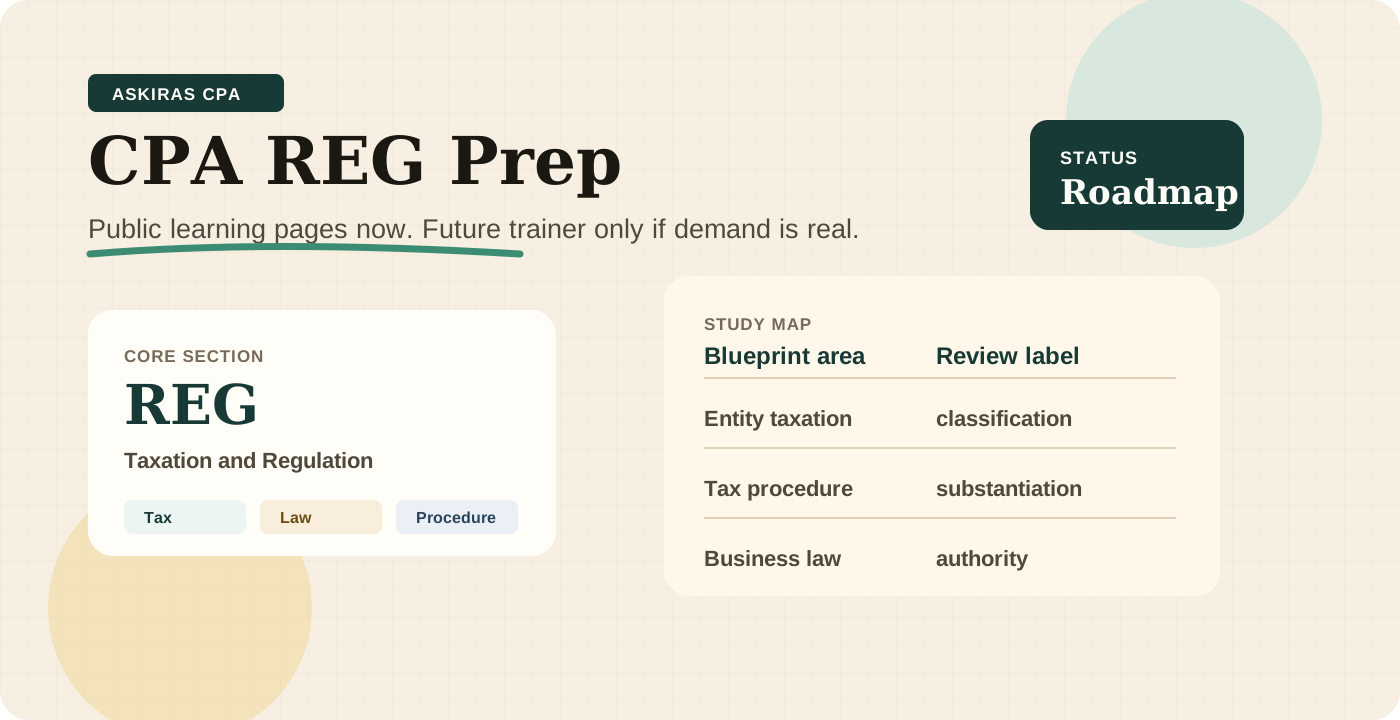
CPA REG covers ethics and federal tax procedures, business law, property transactions, individual taxation, and entity taxation including tax preparation. It is a Core CPA Exam section, not an optional Discipline.
REG in one sentence
CPA REG is the Core section that tests whether a newly licensed CPA can handle tax, ethics, federal tax procedure, business law, property transactions, individual taxation, and entity taxation at the level described in the AICPA Blueprints.
It is not a full tax practice course. It is not a substitute for professional tax, legal, or accounting advice. It is an exam section with defined content areas and task-based simulations.
Source/update note: last reviewed June 29, 2026 against AICPA’s CPA Exam Blueprints page, the AICPA Uniform CPA Examination Blueprints effective January 1, 2026, and NASBA’s CPA Exam page.
The five REG content areas
The 2026 AICPA Blueprint organizes REG into five content areas:
| Area | Blueprint wording | Weight |
|---|---|---|
| I | Ethics, Professional Responsibilities and Federal Tax Procedures | 10-20% |
| II | Business Law | 15-25% |
| III | Federal Taxation of Property Transactions | 5-15% |
| IV | Federal Taxation of Individuals | 22-32% |
| V | Federal Taxation of Entities (including tax preparation) | 23-33% |
Those weights matter because they keep REG from turning into one giant “tax” bucket. Entity taxation and individual taxation are major areas, but ethics, procedure, and law are not optional side quests.
Area I: ethics, responsibilities, and tax procedure
This is where candidates meet tax-practice responsibilities, federal tax procedures, taxpayer penalties, preparer penalties, disclosure, substantiation, privileged communications, and the role of state boards of accountancy.
For Askiras, this is a strong fit for short pattern pages later because many misses come from confusing:
- who has the duty
- what must be disclosed
- what penalty is triggered
- which authority level matters
- whether a record is enough to support a position
The useful study move is not “memorize every penalty table first.” It is to read the fact pattern and identify the actor, duty, deadline, and consequence.
Area II: business law
REG also includes business law. The official area includes agency, contracts, debtor-creditor relationships, selected federal laws and regulations, and business structure.
This is where candidates often make a study mistake: they treat law topics like vocabulary. But business law questions usually reward relationship reading. Who is the agent? Who is the principal? Was there authority? Was a contract formed? What remedy follows?
That makes REG different from a raw tax calculation set. You need scenario reading as much as rule recall.
Areas III, IV, and V: tax application
The remaining REG areas move deeper into federal taxation:
- property transactions
- individual taxation
- entity taxation, including tax preparation
These are the areas that naturally connect to Taxpaperwork’s form-oriented guides. A CPA candidate does not need to treat IRS forms as exam content by themselves. But real forms can make entity choice, tax procedure, and filing context less abstract.
For example, Taxpaperwork’s guide to Form 8832 vs Form 2553 for LLC classification can help you see the real-world paperwork context behind entity classification. That is not the same as memorizing a form for REG. It is context for why the rule exists.
What a REG-first study loop should do
A good REG study loop should force four habits:
- Name the content area.
- Identify the actor, entity, tax year, and transaction.
- Apply the rule without overclaiming facts not in the prompt.
- Review the miss by label, not by shame.
Useful miss labels might be:
- entity classification
- basis
- tax procedure
- preparer responsibility
- business law relationship
- property transaction
- individual deduction or credit
- wrong taxpayer
For a compact first pass, use the short REG section answer and drill to turn the five areas into one miss label and one follow-up set.
That is the Askiras angle in the CPA REG practice: REG practice should make the repeated miss pattern visible.
The honest Askiras boundary
Askiras now offers paid CPA REG practice alongside these free REG pages. It starts with a no-card 7-day free pass and remains educational exam prep, not a full CPA review catalog, CPA certification authority, professional advice, or a pass guarantee.
Askiras is independent and is not affiliated with AICPA, NASBA, Prometric, state boards of accountancy, or CPA Exam administrators. Nothing here is tax, accounting, legal, licensing, or exam-pass advice.
Frequently asked questions
Is REG a required CPA Exam section?
Yes. REG is one of the three Core sections, alongside AUD and FAR.
Is CPA REG mostly tax?
REG is heavily tax-oriented, but it also includes ethics, federal tax procedures, and business law.
Does this guide provide tax or accounting advice?
No. It is exam-prep orientation only. Use official sources and qualified professionals for tax, accounting, legal, licensing, or filing decisions.
Keep going in this exam
Other guides at Askiras
If you are also prepping another exam, these short guides cover the same "name the pattern, then practice" habit.